The following is based on a comment I wrote on Facebook. I'm placing it here so it is more visible and more publicly archived for the benefit of society.
I disagree that legalizing illegal drugs condones an activity. Something being legal is the default state with regard to a any given activity. It is more or less a neutral state. When a new activity comes along, the default assumption is that it's acceptable, because we live in a society where individual liberty is ideally preserved at the expense of every other consideration except immediately deadly acts, ones that immediately threaten national security, and ones that destroy/infringe the integrity of others' property/person(I might be missing something).
It takes directed legal action to make something illegal.
Condoning an activity in society is when the government promotes or subsidizes an activity. This can be done by way of encouragement through communication or giving money to those who participate in the activity.
Marijuana activists are not asking for subsidies or promotion from the government. In fact, I'm quite sure most would accept government condemnation through strong regulation, anti-marijuana abuse education, and lots of taxes.
When you make an activity illegal, you actively commit society to remove people's liberty and punish those who participate in the activity. Marijuana being illegal is not a default inert state, where making it legal would condone the activity. It takes active funding of police action in government budgets every year to enforce the punishment of those who participate in this action through arrests, prosecution, fines, property confiscation, and jail time. You're removing people's liberty to do an activity that meets none of the requirements for an action that should be punished under the law.
This is why marijuana posession and consumption should be reverted to its default state of being neutrally legal, and condemned by the government in an appropriate way through regulation, education, and taxes.
Friday, March 05, 2010

Friday, November 20, 2009
Podcasts I'm following currently
I thought I'd list the audio podcasts I'm following currently, in case anyone is interested to have some good audio to listen to. My selections are basically comprised of Linux-related shows and Public Radio shows.
- FLOSS Weekly
I only recently started listening to this podcast. One of the hosts is Randal Schwartz, who is a legendary writer of Perl programming books. Each episode of this show is an interview with a FLOSS project or organization. It's a good way to get to know the people behind various free software projects, which is pretty cool.
- Le Show
This is a political satire show hosted by Harry Shearer of Simpsons fame. You know his voice most notably as that of Mr. Burns from The Simpsons. He discusses the events of the previous week with a cutting wit and sarcasm. He also employs his talent for voice impersonations(sometimes put to music) to mock and criticize politicians. The show has interludes of music hand-picked by Mr. Shearer.
- Linux Outlaws
A guy from Germany and a guy from England talk about the latest in Linux. They cover the latest software releases and news events, with a special segment covering Microsoft. They're very funny, entertaining guys with reasonable views on controversial topics.
- Planet Money
A discussion of financial news and relevant topics by a few NPR journalists. Their goal is to present complex financial topics in language that anyone can understand. I certainly can. They delve deeper into topics that usually are covered by standard slogans and sound bites in the mainstream press.
- Media Matters
A University of Illinois professor of journalism and media activist named Bob McChesney interviews well-regarded people to discuss media and politics. He is very liberal. Not MSNBC liberal. Truly liberal. This is a local show on our public radio station WILL, but it's evidently very well-known as a podcast, as I've heard it mentioned by someone who had never been to Champaign-Urbana. Very potent and intellectual dialogue.
- Radio Lab
A most excellent radio show that discusses a particular scientific topic for a given episode in a highly entertaining way. Topics include: Parasites, Choice, Stochasticity, After Life, Laughter, etc. There's a complete list on the site. The audio editing done on this show is second-to-none, and it makes all the difference. The topics come alive in a magical way as scientists are interviewed about great experiments they've done, fascinating observations, and debunking common myths.
- Ubuntu UK Podcast
As I'm an avid Ubuntu user, it would make sense to listen to a podcast about it. The Ubuntu UK podcast is hosted by the Ubuntu UK LoCo Team, including Alan Pope, who is a fairly well-known guy in the Ubuntu community.
Tuesday, April 21, 2009
Promoting Free Content
Nearing the end of the OpenCamp event, we discussed the future of OpenEverything and related events. I suggest(ed) that we must first appeal to the most common attitude of most people in order to bring awareness of the benefits of openness in our society.
For example, most people are oriented toward consuming media and acquiring 'things'. If one would like to promote openness in media, create an event in which people are invited to download music/video that is licensed under creative commons.
You set up computers and projectors and speakers in a highly trafficked room to let people play media and allow them to plug in their own storage to download it. People get to fill up their CDs and thumb drives with tons of free music and movies all legally and free. Make sure some impressive music & video is playing to show bystanders that free content can be high quality.
For example, most people are oriented toward consuming media and acquiring 'things'. If one would like to promote openness in media, create an event in which people are invited to download music/video that is licensed under creative commons.
You set up computers and projectors and speakers in a highly trafficked room to let people play media and allow them to plug in their own storage to download it. People get to fill up their CDs and thumb drives with tons of free music and movies all legally and free. Make sure some impressive music & video is playing to show bystanders that free content can be high quality.
OpenCamp
Last weekend Rachel and I went up to Madison, WI to attend the OpenCamp, which was on the 18th of April. It was quite an enjoyable weekend. You can take a look at our pics if you'd like.
Our travel experience itself was rather interesting, in mode if not saliency. We first took a train from Champaign up to Chicago. There is no train from Chicago to Madison, so we rented a Zipcar(a blue Nissan Versa) and drove to Madison. There are a number of Zipcars fairly close to Union Station in Chicago, so it was easy to walk to it.
We stayed with Alnisa Allgood, a non-profit IT specialist in the Madison area who was one of the organizers of OpenCamp. She was very hospitable and sweet to us. She treated us to brunch on Sunday at Iron Works Cafe, which was very enjoyable.
This event was associated with the Open Everything organization, which is a loose organization trying to motivate people to move toward an open society. This means, in general, transparency, freedom, sharing, choice, etc in all aspects of life. The thesis is that when society works in an open way, it works better most of the time. This movement mostly originates from the software freedom movement, and also has influences from the creative commons movement.
It wasn't a very large group, maybe 25 people attended. There were no invited speakers. It was conducted in an "unconference" style. This means we assembled topics and schedules ad hoc, once we got there. Here's what the schedule looked like:
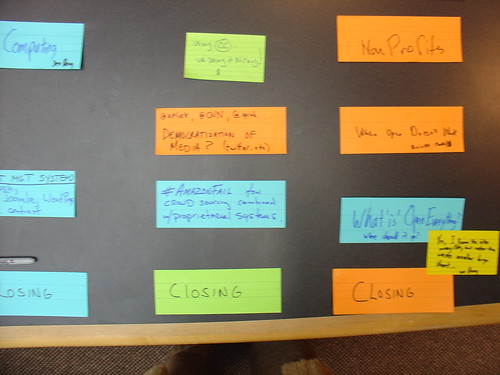
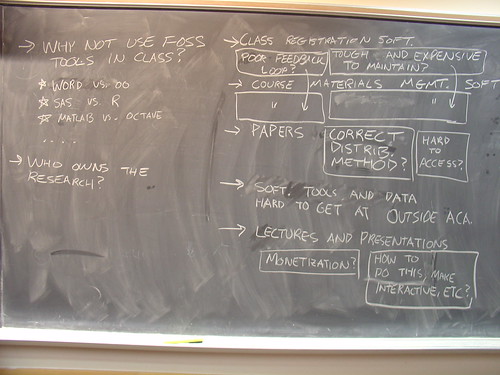
I ran(or at least scheduled) a session on openness in academia and education. We mostly talked over openness in the software used in classes, such as Blackboard(which I am unlucky enough to use in my teaching). We also discussed openness in publication and sharing of knowledge, as well as public policy on using tax payer's money to fund proprietary solutions to public schools' information technology needs. A fellow attendee took some notes on our discussion, as well:
We also had a session on The Pirate Bay, whose founders were recently convicted of conspiracy to infringe copyright. Most of the discussions at this whole event seemed to reduce down to a discussion of what copyright policy should be, and what can people claim to own? Is immaterial property indeed "imaginary property"?
At lunch time we had a walk on State Street, which is the main commercial center on the campus. Rachel and I split off from the group(who had wandered into Chipotle) and ate at a European-style cafe. We enjoyed an Izze drink, a cup of split pea soup, and some cheese bread(referred to as a sun bun).
Douglas Whitfield and Alnisa Allgood did an excellent job facilitating the event, and I hope to continue collaboration and communication with them.
The next day Rachel and I visited Olbrich Gardens, which was a short walk from Alnisa's house, and was quite relaxing. We then drove downtown and saw a bike race going on around the capitol building, and we looked in all the little shops on State Street. A good weekend and much needed travel.
Our travel experience itself was rather interesting, in mode if not saliency. We first took a train from Champaign up to Chicago. There is no train from Chicago to Madison, so we rented a Zipcar(a blue Nissan Versa) and drove to Madison. There are a number of Zipcars fairly close to Union Station in Chicago, so it was easy to walk to it.
We stayed with Alnisa Allgood, a non-profit IT specialist in the Madison area who was one of the organizers of OpenCamp. She was very hospitable and sweet to us. She treated us to brunch on Sunday at Iron Works Cafe, which was very enjoyable.
This event was associated with the Open Everything organization, which is a loose organization trying to motivate people to move toward an open society. This means, in general, transparency, freedom, sharing, choice, etc in all aspects of life. The thesis is that when society works in an open way, it works better most of the time. This movement mostly originates from the software freedom movement, and also has influences from the creative commons movement.
It wasn't a very large group, maybe 25 people attended. There were no invited speakers. It was conducted in an "unconference" style. This means we assembled topics and schedules ad hoc, once we got there. Here's what the schedule looked like:
I ran(or at least scheduled) a session on openness in academia and education. We mostly talked over openness in the software used in classes, such as Blackboard(which I am unlucky enough to use in my teaching). We also discussed openness in publication and sharing of knowledge, as well as public policy on using tax payer's money to fund proprietary solutions to public schools' information technology needs. A fellow attendee took some notes on our discussion, as well:
We also had a session on The Pirate Bay, whose founders were recently convicted of conspiracy to infringe copyright. Most of the discussions at this whole event seemed to reduce down to a discussion of what copyright policy should be, and what can people claim to own? Is immaterial property indeed "imaginary property"?
At lunch time we had a walk on State Street, which is the main commercial center on the campus. Rachel and I split off from the group(who had wandered into Chipotle) and ate at a European-style cafe. We enjoyed an Izze drink, a cup of split pea soup, and some cheese bread(referred to as a sun bun).
Douglas Whitfield and Alnisa Allgood did an excellent job facilitating the event, and I hope to continue collaboration and communication with them.
The next day Rachel and I visited Olbrich Gardens, which was a short walk from Alnisa's house, and was quite relaxing. We then drove downtown and saw a bike race going on around the capitol building, and we looked in all the little shops on State Street. A good weekend and much needed travel.
Friday, November 07, 2008
The Significance to Racial Equality of the Election of Barack Obama
This post is in response to a Slashdot post on the election of Barack Obama.
The fact is that there is still a very real discriminatory element in our society toward under-priveleged races. There are certainly many cases in which black people are demonstrably on equal footing with the more priveleged social groups, but it is also demonstrable that blacks continue to be underserved because of their skin color, in a significant number of cases to make it a problem.
I don't think the people saying they're finally on equal ground really believe there will be no longer a bias against them, nor did they not work toward the highest pursuits in our society before Obama was elected.
I think what they really mean, the right way to interpret their claim to be finally on 'equal ground', is that there is now proof that the consensus of the country is that it can accept blacks into any position in the country. This consensus existed for some time before Obama was elected, but we don't know how long. But we know that before a certain time, the consensus was that a black person could never be president of the USA.
In the end, it's a question of power. The black race began in the US at the bottom echelon of society, and were treated as such. Now, to have someone of that race at the very top echelon of our society, in the most powerful position in the entire world. One could see it as the final desegregation.
It means they have representatives working from the very top end of our society, advocating for them, even subconsciously, and the subconsciouses of people in our country will slowly change, seeing a black person as their leader. It will no longer be out of the question, and from now on, no position of power will be as biased against blacks because of the question as to whether or not blacks are capable or should be trusted with such power. Now people will become more comfortable with a black people having power over them.
To sum up, this election is both a proof of something that's been true for some time, and also an impetus for a shift in our society, though both have been and will be rather subtle.
:-)
Tuesday, August 12, 2008
Doctor Horrible

If you're a fan of Joss Whedon, you'll love Doctor Horrible's Sing-Along Video Blog.
It's a story about a dorky evil mad scientist(Neil Patrick Harris, of Doogie Houser fame) who publishes a public video blog. The story spends little time with that, however. It mostly centers around his crush on a girl he sees at the laundromat that he's too shy to talk to. It's also about his neverending battle against his nemesis, Captain Hammer(Nathan Fillion, of Firefly fame). The lovely woman who completes this eventual love triangle is Felicia Day(of Buffy the Vampire Slayer).
You can watch it online. But if you like it, please buy the episodes on iTunes to show your support. This is a very innovative piece of art with a high level of production quality.

Felicia Day is a prolific web content creator these days. She has another great series that she created and stars in called The Guild. It's about people who play World of Warcraft(well, not by name) all day everyday. I enjoyed the first season. The second should be released in October.
Thursday, February 28, 2008
HP tx2000z
So, do you see the computer that is being used in the video below? It's this one:
This is one of the best tablet pc's in production at the moment: the HP tx2000z. I want to be able to take notes with this machine. And play Crayon Physics Deluxe.
Why do I want a tablet pc? I believe that interface is where the real benefit of computers comes from, and it's the future of the best innovation. tablet pc's are a well-established yet front line technology toward making computers and humans coexist in greater harmony.
What's in a note?
I don't write down notes too often, really. I do it when I feel it's expected of me, and sometimes not even then. There are some things that need to be noted, though. My thoughts about my research, for instance. It's really really hard to hold all the good ideas you have in your head indefinitely. Since I really really want to graduate with a PhD, I need to hold those good ideas in a more permanent form. Notes occasionally help improve my grades, though not that often. For daily and weekly activities, my brain is good enough. I write down noticeably less than most people. Since I tend to read and write slowly, I prefer to listen and be able to respond quickly, rather than being bogged down with writing what was said 30 seconds ago.
This is a problem, don't you know. People often take down notes under time pressure. People also want notes that give them the most information in the quickest way possible. Note-taking is an internal discourse that allows you to connect ideas over long periods of time, and very efficiently. Since I began contributing a couple bug fixes to the open source note-taking program called Tomboy, I've become aware of what kinds of features are most useful for note-takers. This experience has led me to researching note-taking in depth.
I really love Tomboy because it sits right where I spend most of my time: inside my computer. It's simple and intuitive for me, and it's more flexible and compact than writing on paper. For instance, I can link to websites. I can also link to other notes, which I've found is an amazing feature when I want to take notes on multiple academic papers within a particular field...like my note-taking research!

What would make Tomboy better? Well, the main problem is that it lacks free-form control of note formatting and writing. In other words, you use it like a flexible word processor. Being able to "draw" your notes is huge for humans. OK, let's take a step back from drawing. This is clearly beyond the scope of Tomboy, which is supposed to be "simple". How about an implementation of an ad-hoc layout manipulator, in which movements of the mouse determine the shape and position of text on the screen either future, present or past.
Don't quite know what I'm talking about? Well, take a look at the video demonstrating Crayon Physics Deluxe in the next post!
Saturday, October 27, 2007
Remember, Remember, The Fifth of November
I've noticed a clever fund-raising campaign by the republican presidential candidate, Ron Paul.
Referencing the movie V for Vendetta, the Ron Paul campaign has fairly explicitly compared their candidate to the character "V" from the movie, who compares himself to a historical British revolutionary named Guy Fawkes, about whom the following rhyme is recited in Britain:
Remember, remember the fifth of November,
The gunpowder, treason and plot,
I know of no reason why the gunpowder treason
Should ever be forgot.
The implication is that Ron Paul intends to overthrow the government, though not by an act of terrorism as his counterparts attempted(they both attempted to blow up the British parliament building, but "V" succeeded). He intends to use his massive underground movement to raise $10 million on November 5th and send a shockwave through the mainstream press.
Will it work? We'll see...I'm tempted to give $100 myself to be a part of it, because in my opinion the US government has gone too long without a thorough shake-up. I'm also tempted to register Republican(I've always registered independent) so I can support him in the primary.
Tuesday, October 23, 2007
Monday, July 09, 2007
Confrontation
I have found that I lack the will/courage/nerve to confront practically anything in my life. It's very interesting. This trend goes to the extent that I have trouble even forming opinions about things. Or rather, I find most anything for which one could have an opinion to be agreeable to my liking and generally have to be shown otherwise.
Most of my opinions that I do form seem to center on the logic of the matter. I feel rather like Mr. Spock of Star Trek sometimes, recently. It doesn't really matter to me if I actually agree with some action/belief. But if there is a logic I can formulate around how the action came to be completed or the belief came to be believed, then I am OK with it, and I might even like it.
Most of my opinions that I do form seem to center on the logic of the matter. I feel rather like Mr. Spock of Star Trek sometimes, recently. It doesn't really matter to me if I actually agree with some action/belief. But if there is a logic I can formulate around how the action came to be completed or the belief came to be believed, then I am OK with it, and I might even like it.
Thursday, May 24, 2007
Dell And Ubuntu, Sitting In A Tree
Today, Dell released their first line of computers preloaded with the Ubuntu operating system. This most promising alternative to Windows is used by Michael Dell himself on his primary computer.
The importance of the release goes beyond the benefit of having a choice of operating system when you shop at Dell. The importance lies in the fact that Dell has a mighty influence over hardware vendors. One of the greatest stumbling blocks for Linux has been the lack of hardware support, since there is no financial incentive for hardware vendors to support an operating system with no major OEM support. And if there's no hardware support, then the major OEMs have no incentive to provide Ubuntu.
If these systems sell to expectations, and Dell can continue producing new models preloaded with Ubuntu, Dell will(and already is) leverage its influence to force hardware vendors to fully support Linux in its hardware driver software.
The downside of their current offering is that Dell isn't preloading media codecs that require royalties to be paid(MP3, DVD playback, etc.). This means any normal user who wants to use these common media formats will have to acquire them illegally. Dell is working to be able to offer these codecs eventually, though.
Lastly, the new systems are not available through the main website links, but you have to go to http://www.dell.com/open in order to find these systems. Dell explicitly states that they intend the current offerings for people who already know what they're doing. Hopefully, as the system-wide support becomes comparable with Windows, they will simply include Ubuntu in the drop-down list of available operating systems.
Here here! Hooray for Dell and Ubuntu!
The importance of the release goes beyond the benefit of having a choice of operating system when you shop at Dell. The importance lies in the fact that Dell has a mighty influence over hardware vendors. One of the greatest stumbling blocks for Linux has been the lack of hardware support, since there is no financial incentive for hardware vendors to support an operating system with no major OEM support. And if there's no hardware support, then the major OEMs have no incentive to provide Ubuntu.
If these systems sell to expectations, and Dell can continue producing new models preloaded with Ubuntu, Dell will(and already is) leverage its influence to force hardware vendors to fully support Linux in its hardware driver software.
The downside of their current offering is that Dell isn't preloading media codecs that require royalties to be paid(MP3, DVD playback, etc.). This means any normal user who wants to use these common media formats will have to acquire them illegally. Dell is working to be able to offer these codecs eventually, though.
Lastly, the new systems are not available through the main website links, but you have to go to http://www.dell.com/open in order to find these systems. Dell explicitly states that they intend the current offerings for people who already know what they're doing. Hopefully, as the system-wide support becomes comparable with Windows, they will simply include Ubuntu in the drop-down list of available operating systems.
Here here! Hooray for Dell and Ubuntu!
Thursday, May 03, 2007
Sunday, April 15, 2007
Farewell to a Hard Drive
A week ago, my computer's hard drive stopped booting. I ran out to Best Buy immediately and bought a new Western Digital Scorpio Hard Drive with 120 GB capacity(double the capacity of my ailing 60GB Hitachi Travelstar) and I loaded a fresh install of Ubuntu Edgy Eft on it. I happened to have backed up my data about 6 months ago, so I got my old stuff back immediately. But, as I have some mission critical data that was not backed up, I had to retrieve this data.
If you've never had this happen to you, it's quite nerve-wracking. As you may know, most all of my productive work takes place in coordination with my computer, and thus, a hard drive on that computer. If the hard drive dies, I must retrieve what's on it, because I've spent countless hours developing my projects and will reuse the resources from them in the future.
I took the drive to a computer repair shop that has been helpful before, and tends not to charge me anything. After a few days with them, they were not able to recover my data, since the drive would not boot. Oh crap, what was I going to do about this? A professional repair shop can't even get my hard drive to boot, so what hope do I have that won't cost me an arm and a leg? Oh well, at least they didn't charge me...
But, I had one trick up my sleeve yet! I read on the web about a certain technique of hard drive data recovery that involves placing the hard drive in the freezer for an arbitrary but significant amount of time. The principle behind it is that if some part in the hardware is out of alignment, the cold temperature will cause the metal to contract and possibly snap back into alignment.
So, having nothing to lose, I put the HDD in the freezer for an hour. No effect! I put it in again for three hours. Still nothing... Then I left it in the freezer for about twelve hours over night. When I tried it again, the motherboard wouldn't even recognize the hard drive!(until the drive warmed up again)
Well, that didn't work... But I remembered one comment I'd seen in reading forums about this freezing technique, and that one person had had success with the opposite technique: heating up the hard drive, thus causing the parts to expand. I have this little space heater that I use when it's cold. So I decided to give the heat idea a try. What I did was to put the heater on its back, so it pointed at the ceiling, then place the hard drive on top and put a towel over the whole thing. Then I plug in the heater and heat the hard drive for 3 minutes on each side. You have to be very careful and pick up the drive with a towel, because it's like touching a pot that's been on a stove.
So, after doing this, the hard drive got a little further! I couldn't believe it! It still didn't work, but it encouraged me to keep on trying to heat it up. After another round it actually tried to boot up! But then as it got cool it stopped working again. But after I heated the drive another time, I was able to get the drive to boot and look at all my data! I was able to then copy my most important stuff to my flash drive and upload the rest to a school server. I had to upload to the server because the drive stopped wanting to be written to after a few minutes of being booted up, and wouldn't mount my flash drive or my new hard drive. Occasionally I had to hold my computer over the space heater when it started to lock up again.
Hopefully this will help some people who are at their wits' end about recovering their hard drive :-)
If you've never had this happen to you, it's quite nerve-wracking. As you may know, most all of my productive work takes place in coordination with my computer, and thus, a hard drive on that computer. If the hard drive dies, I must retrieve what's on it, because I've spent countless hours developing my projects and will reuse the resources from them in the future.
I took the drive to a computer repair shop that has been helpful before, and tends not to charge me anything. After a few days with them, they were not able to recover my data, since the drive would not boot. Oh crap, what was I going to do about this? A professional repair shop can't even get my hard drive to boot, so what hope do I have that won't cost me an arm and a leg? Oh well, at least they didn't charge me...
But, I had one trick up my sleeve yet! I read on the web about a certain technique of hard drive data recovery that involves placing the hard drive in the freezer for an arbitrary but significant amount of time. The principle behind it is that if some part in the hardware is out of alignment, the cold temperature will cause the metal to contract and possibly snap back into alignment.
So, having nothing to lose, I put the HDD in the freezer for an hour. No effect! I put it in again for three hours. Still nothing... Then I left it in the freezer for about twelve hours over night. When I tried it again, the motherboard wouldn't even recognize the hard drive!(until the drive warmed up again)
Well, that didn't work... But I remembered one comment I'd seen in reading forums about this freezing technique, and that one person had had success with the opposite technique: heating up the hard drive, thus causing the parts to expand. I have this little space heater that I use when it's cold. So I decided to give the heat idea a try. What I did was to put the heater on its back, so it pointed at the ceiling, then place the hard drive on top and put a towel over the whole thing. Then I plug in the heater and heat the hard drive for 3 minutes on each side. You have to be very careful and pick up the drive with a towel, because it's like touching a pot that's been on a stove.
So, after doing this, the hard drive got a little further! I couldn't believe it! It still didn't work, but it encouraged me to keep on trying to heat it up. After another round it actually tried to boot up! But then as it got cool it stopped working again. But after I heated the drive another time, I was able to get the drive to boot and look at all my data! I was able to then copy my most important stuff to my flash drive and upload the rest to a school server. I had to upload to the server because the drive stopped wanting to be written to after a few minutes of being booted up, and wouldn't mount my flash drive or my new hard drive. Occasionally I had to hold my computer over the space heater when it started to lock up again.
Hopefully this will help some people who are at their wits' end about recovering their hard drive :-)
Thursday, April 12, 2007
Wednesday, April 11, 2007
We Won SemEval!
Actually, I'm not sure how we won, but we did...we've been getting a lot of congratulations from professors in our department and such, but I still don't know how we had the best system. It seemed so last minute and ad hoc. We had 1 1/2 months to code our system, and there were 13 other teams from around the country(and in the UK).
Also, I am excited about Feisty Fawn, the next version of Ubuntu, which is being released on the 19th of April. If you haven't tried out Ubuntu yet, this is your chance! It's supposed to have the state of the art in networking and will include many multimedia codecs by default.
Also, I am excited about Feisty Fawn, the next version of Ubuntu, which is being released on the 19th of April. If you haven't tried out Ubuntu yet, this is your chance! It's supposed to have the state of the art in networking and will include many multimedia codecs by default.
Friday, March 30, 2007
SemEval 2007
 Picture: Christmas 2005, Rachel's Aunt Amy's house in northwestern Ohio.
From left: Erin Drum(Rachel's sister), me, Rachel Drum(my fiance), Kevin Drum(Rachel's brother), Pam Drum(Rachel's Mom), Bruce Drum(Rachel's Dad)
I thought you might be interested to hear about a project I've been working on :-)
This semester I'm taking a seminar in which we are competing in a sort of academic task called SemEval 2007. SemEval offers the oppourtunity for participants(mostly teams at universities, like ours) to attempt a variety of tasks related to automated semantic evaluation. The professor who is teaching the course, Roxana Girju, helped to organize one of the tasks, and so of course we are working on that one. It is task 4, "Classification of Semantic Relations between Nominals".
So, what does that entail? Basically, we're given a bunch of sentences with two nouns marked on each sentence, and most of the time the exact meanings of the marked nouns. We must write a computer program that automagically determines whether or not the two marked nouns have a particular semantic relation. There are seven semantic relations that we have to sort out, so it's not too bad. Here's an example of what we get:
001 "The period of [e1]tumor shrinkage[/e1] after [e2]radiation therapy[/e2] is often long and varied (mean months)."
WordNet(e1) = "shrinkage%1:11:00::", WordNet(e2) = "radiation_therapy%1:04:00::", Cause-Effect(e2,e1) = "true", Query = "* after radiation therapy"
The first line is the sentence, which has "tumor shrinkage" and "radiation therapy" marked. The second line is a reference to the exact Wordnet definition, or "sense", of each marked noun. It also displays the relevant semantic relation, Cause-Effect, which in this case is labeled as a true relation between the two nouns. That is, radiation therapy causes tumor shrinkage, which is straightforward enough for anyone to understand, and this is what is meant by Cause-Effect. The Query indicates a Google search that led the task moderators to this sentence, which comes from the web.
So what's the point of doing this task? A primary application is as an aid to question answering computer programs. For example, suppose you're a doctor and you want to know what shrinks tumors. Suppose there's this amazing program where the doctor can just type in a question and out comes the answer: "radiation therapy". In order to get this answer, the program can search the web, find a sentence like the one given above, and somehow figure out that "radiation therapy" is in a Cause-Effect relationship to "tumor shrinkage". To figure out this "somehow" is the goal of this task.
The deadline for submitting our results is Sunday, so I'll let you know how we do!
Saturday, March 17, 2007
Why Is The Study of Art Important?
My love Rachel is an artist of a particular sort where she is encouraged to pursue her art explicitly and even formally. She works to make her art a truer expression of herself, ever expanding her modes of expression in order to come to a closer understanding of herself and her world around her.
But what is the importance of this pursuit? Why would someone choose art as an intellectual life pursuit, rather than the other two fields of intellectual pursuit: philosophy and science?
All three of these areas are essential to any human's life. You cannot have a healthy pursuit of any of these without the other two. But are they really on equal ground? Our society certainly puts the highest value on science.
I will make the case for art. What is it? Art is the expression that is in harmony with God's creative purpose. The ideal of this expression is to use the full potential of the human mind and body to express the "naturalness" of humanity, in whatever way. We are not perfect, and we do not use our full potential, so we do not possess this ability to its utmost extent, nor can anyone fully attain it.
This is why one must work at artful expression their whole lives in order to gain a proficiency with it. This is also why it is a special thing when someone is recognized for their "artistic abilities". What is really being recognized there? It is the ability of someone to use their human potential of expression.
But what is the purpose of art? It is the same as all other academic pursuit(philosophy and science), when pursued intellectually. The purpose is to find truth, to fill ourselves with knowledge of the world. How does art do this? By expressing ourselves more fully, we uncover the state of the world in profound ways. Things that are unclear to people become clear. We can view how people from different cultures see the world, compared to our own. We can see the human body and mind do something it was not known to do before. By an artist's interaction with the natural world truths about the close connection between certain things in nature may be revealed where scientists and philosophers may have overlooked these things up until now. The beauty of it all reveals a knowledge that God meant for us to be able to reach this potential, even if we ourselves are not able to do what the artist does. Because of this we see God's purpose in creating us, the goodness He has in mind.
The painter, the comedian, the computer programmer, the martial artist, the musician...great people in all these pursuits have shown new horizons of human potential, and have revealed truths of the world that have spurred on the scientists of today.
Would scientists bother to study harmonic physics if it were not for the musicians first expressing the possibilities of creating beautiful sounds?
Would scientists have bothered to consider the possibility of a theory of human evolution without the painters and sculptors first expressing our close relation to other animals in art of most all cultures?
Of course, I don't know for sure, but it seems plausible that in these and many other instances, it is artists that first stumble upon truths about the world, and proceed to inspire philosophers and scientists to make a pursuit of it themselves, in their own ways.
We need artists everywhere in the world.
Artists make us less ignorant of our world.
Artists make the world more peaceful.
But what is the importance of this pursuit? Why would someone choose art as an intellectual life pursuit, rather than the other two fields of intellectual pursuit: philosophy and science?
All three of these areas are essential to any human's life. You cannot have a healthy pursuit of any of these without the other two. But are they really on equal ground? Our society certainly puts the highest value on science.
I will make the case for art. What is it? Art is the expression that is in harmony with God's creative purpose. The ideal of this expression is to use the full potential of the human mind and body to express the "naturalness" of humanity, in whatever way. We are not perfect, and we do not use our full potential, so we do not possess this ability to its utmost extent, nor can anyone fully attain it.
This is why one must work at artful expression their whole lives in order to gain a proficiency with it. This is also why it is a special thing when someone is recognized for their "artistic abilities". What is really being recognized there? It is the ability of someone to use their human potential of expression.
But what is the purpose of art? It is the same as all other academic pursuit(philosophy and science), when pursued intellectually. The purpose is to find truth, to fill ourselves with knowledge of the world. How does art do this? By expressing ourselves more fully, we uncover the state of the world in profound ways. Things that are unclear to people become clear. We can view how people from different cultures see the world, compared to our own. We can see the human body and mind do something it was not known to do before. By an artist's interaction with the natural world truths about the close connection between certain things in nature may be revealed where scientists and philosophers may have overlooked these things up until now. The beauty of it all reveals a knowledge that God meant for us to be able to reach this potential, even if we ourselves are not able to do what the artist does. Because of this we see God's purpose in creating us, the goodness He has in mind.
The painter, the comedian, the computer programmer, the martial artist, the musician...great people in all these pursuits have shown new horizons of human potential, and have revealed truths of the world that have spurred on the scientists of today.
Would scientists bother to study harmonic physics if it were not for the musicians first expressing the possibilities of creating beautiful sounds?
Would scientists have bothered to consider the possibility of a theory of human evolution without the painters and sculptors first expressing our close relation to other animals in art of most all cultures?
Of course, I don't know for sure, but it seems plausible that in these and many other instances, it is artists that first stumble upon truths about the world, and proceed to inspire philosophers and scientists to make a pursuit of it themselves, in their own ways.
We need artists everywhere in the world.
Artists make us less ignorant of our world.
Artists make the world more peaceful.
Thursday, March 08, 2007
Jorge Cham Visits UIUC
This evening I had the pleasure of attending a lecture by the creator of the web comic known as Piled Higher and Deeper. This comic, if you haven't read it, is a very inspiring/depressing/comedic take on the life of a graduate student(that is, my life). What I enjoy about these comics is that I can relate precisely to many of them. Jorge Cham has indeed been through grad school at Stanford, has a PhD in Mechanical Engineering, and understands the plight of the grad student.
The gist of a Jorge Cham talk is to use many comedic devices shown through his various cartoons and a fairly well-reasoned argument why procrastination is healthy for grad students. Supposedly 1 in 200 graduate students makes an attempt at suicide O_O How lovely, indeed. That's what happens when you don't procrastinate! No, really! :-P
A few highlights. In his talk, Jorge brought up that only 4 Hollywood movies about grad students have ever been made. These are: Hulk(2003), A Beautiful Mind(2001), Real Genius(1985), The Seniors(1978). In the question session following his talk, I asked approximately: "Since you brought up the scarcity of movies made about grad students, would you ever consider turning your comic strip into a movie?" His answer was, roughly: "Well, that would be very interesting to try, and since I live in Pasadena, which is right near Hollywood, you pretty much have to be working on a screenplay. So maybe I'll give it a shot." Pretty promising answer I think :-)
An undergraduate Linguistics student I know, Ben Lawitts, found me after the talk and told me he was going to try and get Jorge to go to The Blind Pig and have a drink with the Linguistics grad students who meet there every Thursday night. Jorge wasn't against the idea, but methinks he won't end up there tonight. What was funny is that this Ben Lawitts just got his head shaved, and had Jorge sign his head! Jorge was a bit taken aback at first, but drew a lightbulb and signed Ben's head, giggling the whole time. The director of the Graduate College asked to take a couple pictures of Ben, which I was promised to receive in due course, so you will get to see this. A funny quote from Jorge after agreeing to sign Ben's head: "This doesn't mean you'll be in my comic!"
Lastly, a school newspaper journalist interviewed Ben and me about the talk, and I expect my comments will appear in The Daily Illini tomorrow. ^_^
The gist of a Jorge Cham talk is to use many comedic devices shown through his various cartoons and a fairly well-reasoned argument why procrastination is healthy for grad students. Supposedly 1 in 200 graduate students makes an attempt at suicide O_O How lovely, indeed. That's what happens when you don't procrastinate! No, really! :-P
A few highlights. In his talk, Jorge brought up that only 4 Hollywood movies about grad students have ever been made. These are: Hulk(2003), A Beautiful Mind(2001), Real Genius(1985), The Seniors(1978). In the question session following his talk, I asked approximately: "Since you brought up the scarcity of movies made about grad students, would you ever consider turning your comic strip into a movie?" His answer was, roughly: "Well, that would be very interesting to try, and since I live in Pasadena, which is right near Hollywood, you pretty much have to be working on a screenplay. So maybe I'll give it a shot." Pretty promising answer I think :-)
An undergraduate Linguistics student I know, Ben Lawitts, found me after the talk and told me he was going to try and get Jorge to go to The Blind Pig and have a drink with the Linguistics grad students who meet there every Thursday night. Jorge wasn't against the idea, but methinks he won't end up there tonight. What was funny is that this Ben Lawitts just got his head shaved, and had Jorge sign his head! Jorge was a bit taken aback at first, but drew a lightbulb and signed Ben's head, giggling the whole time. The director of the Graduate College asked to take a couple pictures of Ben, which I was promised to receive in due course, so you will get to see this. A funny quote from Jorge after agreeing to sign Ben's head: "This doesn't mean you'll be in my comic!"
Lastly, a school newspaper journalist interviewed Ben and me about the talk, and I expect my comments will appear in The Daily Illini tomorrow. ^_^
Subscribe to:
Posts (Atom)