The following is based on a comment I wrote on Facebook. I'm placing it here so it is more visible and more publicly archived for the benefit of society.
I disagree that legalizing illegal drugs condones an activity. Something being legal is the default state with regard to a any given activity. It is more or less a neutral state. When a new activity comes along, the default assumption is that it's acceptable, because we live in a society where individual liberty is ideally preserved at the expense of every other consideration except immediately deadly acts, ones that immediately threaten national security, and ones that destroy/infringe the integrity of others' property/person(I might be missing something).
It takes directed legal action to make something illegal.
Condoning an activity in society is when the government promotes or subsidizes an activity. This can be done by way of encouragement through communication or giving money to those who participate in the activity.
Marijuana activists are not asking for subsidies or promotion from the government. In fact, I'm quite sure most would accept government condemnation through strong regulation, anti-marijuana abuse education, and lots of taxes.
When you make an activity illegal, you actively commit society to remove people's liberty and punish those who participate in the activity. Marijuana being illegal is not a default inert state, where making it legal would condone the activity. It takes active funding of police action in government budgets every year to enforce the punishment of those who participate in this action through arrests, prosecution, fines, property confiscation, and jail time. You're removing people's liberty to do an activity that meets none of the requirements for an action that should be punished under the law.
This is why marijuana posession and consumption should be reverted to its default state of being neutrally legal, and condemned by the government in an appropriate way through regulation, education, and taxes.
Friday, March 05, 2010

Friday, November 20, 2009
Podcasts I'm following currently
I thought I'd list the audio podcasts I'm following currently, in case anyone is interested to have some good audio to listen to. My selections are basically comprised of Linux-related shows and Public Radio shows.
- FLOSS Weekly
I only recently started listening to this podcast. One of the hosts is Randal Schwartz, who is a legendary writer of Perl programming books. Each episode of this show is an interview with a FLOSS project or organization. It's a good way to get to know the people behind various free software projects, which is pretty cool.
- Le Show
This is a political satire show hosted by Harry Shearer of Simpsons fame. You know his voice most notably as that of Mr. Burns from The Simpsons. He discusses the events of the previous week with a cutting wit and sarcasm. He also employs his talent for voice impersonations(sometimes put to music) to mock and criticize politicians. The show has interludes of music hand-picked by Mr. Shearer.
- Linux Outlaws
A guy from Germany and a guy from England talk about the latest in Linux. They cover the latest software releases and news events, with a special segment covering Microsoft. They're very funny, entertaining guys with reasonable views on controversial topics.
- Planet Money
A discussion of financial news and relevant topics by a few NPR journalists. Their goal is to present complex financial topics in language that anyone can understand. I certainly can. They delve deeper into topics that usually are covered by standard slogans and sound bites in the mainstream press.
- Media Matters
A University of Illinois professor of journalism and media activist named Bob McChesney interviews well-regarded people to discuss media and politics. He is very liberal. Not MSNBC liberal. Truly liberal. This is a local show on our public radio station WILL, but it's evidently very well-known as a podcast, as I've heard it mentioned by someone who had never been to Champaign-Urbana. Very potent and intellectual dialogue.
- Radio Lab
A most excellent radio show that discusses a particular scientific topic for a given episode in a highly entertaining way. Topics include: Parasites, Choice, Stochasticity, After Life, Laughter, etc. There's a complete list on the site. The audio editing done on this show is second-to-none, and it makes all the difference. The topics come alive in a magical way as scientists are interviewed about great experiments they've done, fascinating observations, and debunking common myths.
- Ubuntu UK Podcast
As I'm an avid Ubuntu user, it would make sense to listen to a podcast about it. The Ubuntu UK podcast is hosted by the Ubuntu UK LoCo Team, including Alan Pope, who is a fairly well-known guy in the Ubuntu community.
Tuesday, April 21, 2009
Promoting Free Content
Nearing the end of the OpenCamp event, we discussed the future of OpenEverything and related events. I suggest(ed) that we must first appeal to the most common attitude of most people in order to bring awareness of the benefits of openness in our society.
For example, most people are oriented toward consuming media and acquiring 'things'. If one would like to promote openness in media, create an event in which people are invited to download music/video that is licensed under creative commons.
You set up computers and projectors and speakers in a highly trafficked room to let people play media and allow them to plug in their own storage to download it. People get to fill up their CDs and thumb drives with tons of free music and movies all legally and free. Make sure some impressive music & video is playing to show bystanders that free content can be high quality.
For example, most people are oriented toward consuming media and acquiring 'things'. If one would like to promote openness in media, create an event in which people are invited to download music/video that is licensed under creative commons.
You set up computers and projectors and speakers in a highly trafficked room to let people play media and allow them to plug in their own storage to download it. People get to fill up their CDs and thumb drives with tons of free music and movies all legally and free. Make sure some impressive music & video is playing to show bystanders that free content can be high quality.
OpenCamp
Last weekend Rachel and I went up to Madison, WI to attend the OpenCamp, which was on the 18th of April. It was quite an enjoyable weekend. You can take a look at our pics if you'd like.
Our travel experience itself was rather interesting, in mode if not saliency. We first took a train from Champaign up to Chicago. There is no train from Chicago to Madison, so we rented a Zipcar(a blue Nissan Versa) and drove to Madison. There are a number of Zipcars fairly close to Union Station in Chicago, so it was easy to walk to it.
We stayed with Alnisa Allgood, a non-profit IT specialist in the Madison area who was one of the organizers of OpenCamp. She was very hospitable and sweet to us. She treated us to brunch on Sunday at Iron Works Cafe, which was very enjoyable.
This event was associated with the Open Everything organization, which is a loose organization trying to motivate people to move toward an open society. This means, in general, transparency, freedom, sharing, choice, etc in all aspects of life. The thesis is that when society works in an open way, it works better most of the time. This movement mostly originates from the software freedom movement, and also has influences from the creative commons movement.
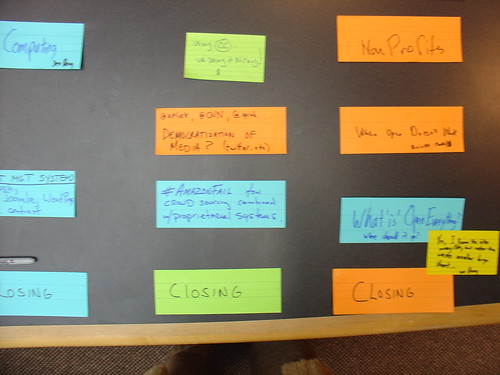
It wasn't a very large group, maybe 25 people attended. There were no invited speakers. It was conducted in an "unconference" style. This means we assembled topics and schedules ad hoc, once we got there. Here's what the schedule looked like:
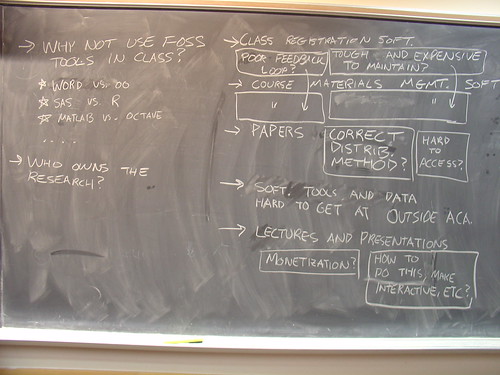
I ran(or at least scheduled) a session on openness in academia and education. We mostly talked over openness in the software used in classes, such as Blackboard(which I am unlucky enough to use in my teaching). We also discussed openness in publication and sharing of knowledge, as well as public policy on using tax payer's money to fund proprietary solutions to public schools' information technology needs. A fellow attendee took some notes on our discussion, as well:
We also had a session on The Pirate Bay, whose founders were recently convicted of conspiracy to infringe copyright. Most of the discussions at this whole event seemed to reduce down to a discussion of what copyright policy should be, and what can people claim to own? Is immaterial property indeed "imaginary property"?
At lunch time we had a walk on State Street, which is the main commercial center on the campus. Rachel and I split off from the group(who had wandered into Chipotle) and ate at a European-style cafe. We enjoyed an Izze drink, a cup of split pea soup, and some cheese bread(referred to as a sun bun).
Douglas Whitfield and Alnisa Allgood did an excellent job facilitating the event, and I hope to continue collaboration and communication with them.
The next day Rachel and I visited Olbrich Gardens, which was a short walk from Alnisa's house, and was quite relaxing. We then drove downtown and saw a bike race going on around the capitol building, and we looked in all the little shops on State Street. A good weekend and much needed travel.
Our travel experience itself was rather interesting, in mode if not saliency. We first took a train from Champaign up to Chicago. There is no train from Chicago to Madison, so we rented a Zipcar(a blue Nissan Versa) and drove to Madison. There are a number of Zipcars fairly close to Union Station in Chicago, so it was easy to walk to it.
We stayed with Alnisa Allgood, a non-profit IT specialist in the Madison area who was one of the organizers of OpenCamp. She was very hospitable and sweet to us. She treated us to brunch on Sunday at Iron Works Cafe, which was very enjoyable.
This event was associated with the Open Everything organization, which is a loose organization trying to motivate people to move toward an open society. This means, in general, transparency, freedom, sharing, choice, etc in all aspects of life. The thesis is that when society works in an open way, it works better most of the time. This movement mostly originates from the software freedom movement, and also has influences from the creative commons movement.
It wasn't a very large group, maybe 25 people attended. There were no invited speakers. It was conducted in an "unconference" style. This means we assembled topics and schedules ad hoc, once we got there. Here's what the schedule looked like:
I ran(or at least scheduled) a session on openness in academia and education. We mostly talked over openness in the software used in classes, such as Blackboard(which I am unlucky enough to use in my teaching). We also discussed openness in publication and sharing of knowledge, as well as public policy on using tax payer's money to fund proprietary solutions to public schools' information technology needs. A fellow attendee took some notes on our discussion, as well:
We also had a session on The Pirate Bay, whose founders were recently convicted of conspiracy to infringe copyright. Most of the discussions at this whole event seemed to reduce down to a discussion of what copyright policy should be, and what can people claim to own? Is immaterial property indeed "imaginary property"?
At lunch time we had a walk on State Street, which is the main commercial center on the campus. Rachel and I split off from the group(who had wandered into Chipotle) and ate at a European-style cafe. We enjoyed an Izze drink, a cup of split pea soup, and some cheese bread(referred to as a sun bun).
Douglas Whitfield and Alnisa Allgood did an excellent job facilitating the event, and I hope to continue collaboration and communication with them.
The next day Rachel and I visited Olbrich Gardens, which was a short walk from Alnisa's house, and was quite relaxing. We then drove downtown and saw a bike race going on around the capitol building, and we looked in all the little shops on State Street. A good weekend and much needed travel.
Friday, November 07, 2008
The Significance to Racial Equality of the Election of Barack Obama
This post is in response to a Slashdot post on the election of Barack Obama.
The fact is that there is still a very real discriminatory element in our society toward under-priveleged races. There are certainly many cases in which black people are demonstrably on equal footing with the more priveleged social groups, but it is also demonstrable that blacks continue to be underserved because of their skin color, in a significant number of cases to make it a problem.
I don't think the people saying they're finally on equal ground really believe there will be no longer a bias against them, nor did they not work toward the highest pursuits in our society before Obama was elected.
I think what they really mean, the right way to interpret their claim to be finally on 'equal ground', is that there is now proof that the consensus of the country is that it can accept blacks into any position in the country. This consensus existed for some time before Obama was elected, but we don't know how long. But we know that before a certain time, the consensus was that a black person could never be president of the USA.
In the end, it's a question of power. The black race began in the US at the bottom echelon of society, and were treated as such. Now, to have someone of that race at the very top echelon of our society, in the most powerful position in the entire world. One could see it as the final desegregation.
It means they have representatives working from the very top end of our society, advocating for them, even subconsciously, and the subconsciouses of people in our country will slowly change, seeing a black person as their leader. It will no longer be out of the question, and from now on, no position of power will be as biased against blacks because of the question as to whether or not blacks are capable or should be trusted with such power. Now people will become more comfortable with a black people having power over them.
To sum up, this election is both a proof of something that's been true for some time, and also an impetus for a shift in our society, though both have been and will be rather subtle.
:-)
Tuesday, August 12, 2008
Doctor Horrible

If you're a fan of Joss Whedon, you'll love Doctor Horrible's Sing-Along Video Blog.
It's a story about a dorky evil mad scientist(Neil Patrick Harris, of Doogie Houser fame) who publishes a public video blog. The story spends little time with that, however. It mostly centers around his crush on a girl he sees at the laundromat that he's too shy to talk to. It's also about his neverending battle against his nemesis, Captain Hammer(Nathan Fillion, of Firefly fame). The lovely woman who completes this eventual love triangle is Felicia Day(of Buffy the Vampire Slayer).
You can watch it online. But if you like it, please buy the episodes on iTunes to show your support. This is a very innovative piece of art with a high level of production quality.

Felicia Day is a prolific web content creator these days. She has another great series that she created and stars in called The Guild. It's about people who play World of Warcraft(well, not by name) all day everyday. I enjoyed the first season. The second should be released in October.
Thursday, February 28, 2008
HP tx2000z
So, do you see the computer that is being used in the video below? It's this one:
This is one of the best tablet pc's in production at the moment: the HP tx2000z. I want to be able to take notes with this machine. And play Crayon Physics Deluxe.
Why do I want a tablet pc? I believe that interface is where the real benefit of computers comes from, and it's the future of the best innovation. tablet pc's are a well-established yet front line technology toward making computers and humans coexist in greater harmony.
Subscribe to:
Posts (Atom)